
Kapitel 5
ADMINISTRATION
Our new administration isinspired by the intelligence of nature,the threefold social organism according to Rudolf Steinerand in resonance with universal natural principles.All regions of the earth are healthy and full of beauty.No one should have to leave their home because of war, pollution,poverty, slavery or economic reasons.Our vision is that one daythere will be no more borders,because we understand that planet Earth provides for us all –and we are all part of the human family.
5.A) TRANSPARENT & FAIR ADMINISTRATION
The administration of villages, regions and countries is simple, clear and efficiently structured.
In our new transparent and co-creative fair administration, there are neither party systems nor lobbying.
People who serve the will of the people as representatives have proven in the past through their actions that they care about the well-being and health of all life.
They are highly competent beyond their area of expertise. They are aware that all areas of life constantly interact with each other.
Their far-reaching and fundamental decisions are made in the spirit that each of them should have a positive impact on the seventh subsequent generation.
There are no special financial incentives or privileges for becoming a representative of the people.
A working group ensures that there can be no abuse of power.
Every action relevant to all people that is carried out by the elected or selected representatives is transparent to everyone.
Each representative takes personal responsibility for their actions.
This prevents laws from being passed that solely benefit the economy but harm the foundations of life, plants, animals or people.
At the same time, each representative with this great responsibility is observed, advised and supported by a ‘Wisdom Council’.
.



5.B) WISDOM COUNCILS & CITIZENS COUNCILS
For each important topic area, there is a ‘Wisdom Council’
These Wisdom Councils are composed of committed and competent women and men whose thinking and actions are based on the well-being of all life.
These individuals are conscious of their own personal conditioning and have integrated the content of courses on mindful and peaceful communication and collaborative decision-making processes.
The representatives of the Wisdom Council represent the diversity of the community: people of all ages, ethnic backgrounds and life experiences. They are thinkers and practitioners who are able to deal constructively with the challenges and solutions of individual population groups and areas of life.
The Wisdom Councils regularly receive further training on relevant topics such as renaturation, agriculture and nutrition, health, potential development, energy, transport, peace, etc.
At the local level, there is a Wisdom Council for every socially or environmentally relevant issue.
These Wisdom Councils are in close communication with the local people and with the Wisdom Councils of the larger regions.
The Wisdom Councils of the larger regions are in close communication with the Wisdom Councils of the countries.
Citizens Councils can also be convened for important decisions or issues.
These councils are composed of up to 100 people selected at random who represent different groups.
Through these Citizens Councils, new ideas, perspectives and concrete proposals for action are developed and presented.
.
5.C) ACTIVE CO-CREATION
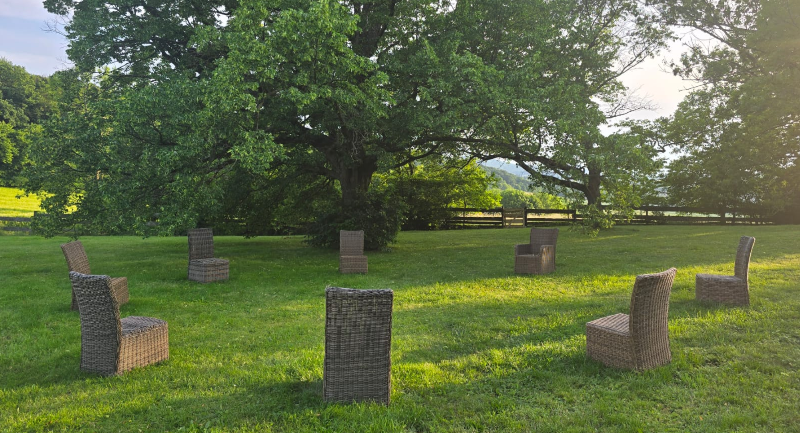
Everybody has the opportunity to learn about what the Wisdom Council or the Citizens Council are currently working on via a digital platform.
Everyone is invited to contribute their constructive ideas and express their wishes on all important topics in ‘Centres of inspiration’.
These ideas are then passed on to the Wisdom Councils.
In this way, people no longer perceive themselves as loose elements of an oppressive system, but as creative co-designers of a large living organism.
A democracy of delegation has thus been transformed into an active community of cooperation and commitment.
.
5.D) A CULTURE OF PARTICIPATORY DECISION-MAKING
To support decision-making, existing models such as sociocracy, holacracy, Yamagishi Kai, Ubuntu, Dragon Dreaming and the Viable System Model (VSM) are being tested in practice and further developed.
Both in decision-making and in the practical implementation of decisions, the guiding principle always applies:
5.E) CONSTITUTIONS OF THE NEW EARTH
The first task of a Wisdom Council is to draft a constitution based on universal principles that treats humans and nature as equals.
The people of the country will vote on this constitution.
THE NEW EARTHMANIFESTO can serve as an inspiring basis for this new constitution.
.
THE UNIVERSAL PRINCIPLES
1. The Principle of MENTALISM
This first Hermetic Principle states that everything is mind.
The origin of all matter and all manifestations of life lies in mind, in pure energy; matter is mind made visible. We shape our reality with our thoughts and feelings. Every thought is therefore a creative process;
it “informs”, that is, it brings “into form”. For you, this means in practical terms
that you can recognise physical reality as a mirror of your inner spiritual state. By doing so, you will experience yourself as the creator of your reality and can begin to take responsibility. You will no longer react to something that seems independent of you, but will know that everything you encounter has its origin in you.
2. The principle of VIBRATION
Everything in our universe is in constant motion, in vibration. Even things that appear to be solid are not actually solid, but are in constant vibration at the subatomic level – quantum physics refers to this as ‘moving, vibrating strings’.
Pure spirit, pure love has the highest of all vibration frequencies – it is said that its vibrational state is so high that it is practically equivalent to rest, just as a rapidly spinning wheel also appears motionless. At the other end of the scale are the coarse forms of matter, whose vibration is so slow that they appear to be at rest. Between these poles, there are countless different degrees of vibration.
In your body, too, every atom, every cell, every organ has a specific vibrational frequency. Every thought you have, every emotion you feel and every action you perform has a vibrational frequency that has a powerful influence on you and your life.
Since love has the highest of all vibrational frequencies, the easiest way to raise your vibrational frequency is to practise loving yourself and everything that is in this moment.
3. The principle of RESONANCE
This principle is often referred to as the ‘law of attraction’.
It states that everything that has a similar vibration frequency or ‘wavelength’ is attracted to each other. There is nothing in our lives that has nothing to do with us. Everything we experience, everything we encounter, we have brought into our lives. Like a radio station, we send the ‘vibrational information’ of our thoughts and feelings out into the universe at every moment of our lives, thereby attracting into our lives what is ‘in tune’ with our vibrational frequency.
Once you understand this, you will take full responsibility for your life and become a conscious creator of your reality. So if you want to change your outer world, you must first change your inner world.
4. The Principle of POLARITY
This principle describes the duality of all things. Everything in the world of appearances has two poles. No pole can exist without its opposite. All apparent opposites are merely extremes of the same thing. For example, ‘heat’ and “cold” are simply two subjective perceptions of ‘temperature’. One cannot say that heat ends here and cold begins there. Both merge into each other and are relative to the observer and context. The apparent opposites touch each other.
Polarity can show us many things: one can only experience light if one knows darkness.
Our own opinions – perspectives and points of view – are never absolute and always contain their opposite. By changing your perspective, something you previously considered negative may now appear positive. Everything is relative. It is our thinking that determines how we evaluate things. We can change our evaluation at any moment.
5. The principle of RHYTHM
Everything in the world of phenomena is subject to change, a constant rhythmic shift from one pole to the other. ‘The only constant in the universe is change,’ wrote Heraclitus.
We breathe in – we breathe out. Life arises and life passes away. Cultures appear – cultures disappear. Mother Earth shows us this principle every day from morning to evening and again from morning to evening. She shows it to us in the rhythm of the seasons, in the rhythm of ebb and flow, in every birth and every death.
This principle can teach us to pay attention to the right time for a project.
At the same time, we can learn to find our centre in all the ‘ups’ and ‘downs’ of our lives and become conscious observers of this cosmic dance instead of seeing ourselves as victims of ever-changing circumstances.
6. The principle of CAUSE AND EFFECT
Every effect has a cause that brought it about. An action is followed by a reaction. Nothing happens by chance. When we describe something as ‘coincidental’, it simply means that we do not know the cause that brought about this event.
You yourself have set the corresponding cause for everything you experience. In other cultures, this is often referred to as ‘karma’. Karma can also mean that we gain insights and learn to see things from a different perspective through the event we have caused.
By becoming aware of the hermetic law of cause and effect, you develop a heightened awareness of the things you send out into the world. You now encounter your thoughts, feelings, words and actions more consciously. The experience and perception of effects in your life also becomes clearer. You recognise that everything serves your well-being and promotes your development.
Once you have become aware of this principle, you will from now on take care to set the causes through your words, feelings and actions that will produce the effects you desire in your future.
7. The principle of GENDER
The principle of gender states that everything has both masculine and feminine qualities. Yin and yang. This applies not only to humans, but to all living beings, from physical objects to spiritual entities.
The masculine principle is: the idea, the will, the active, the giving, the guiding. The female principle is: the accepting, the receiving, the executing, the passive.
In order to create, male and female elements must always come together.
THE TRINITY OF THE SOCIAL ORGANISM
The threefold social order according to Rudolf Steiner
The idea of the threefold social order was developed by Rudolf Steiner (1861–1925), the founder of anthroposophy, during and after the First World War. Steiner was convinced that the profound crises of his time – war, social tensions, spiritual disorientation – stemmed from an imbalance in society. His answer was a new model of society that would divide modern society into three independent but cooperating spheres: spiritual life, legal life and economic life.
1. Spiritual life – freedom
Spiritual life encompasses everything related to education, culture, science, religion, art and upbringing. Steiner demanded that this sphere be organised independently of the state and the economy. Only in freedom could creativity, individuality and spiritual development flourish.
Examples of spiritual life:
- Schools and universities
- Cultural institutions (theatres, museums)
- Churches and spiritual communities
Central principle: Freedom
→ Every person should be able to develop their spiritual abilities freely, without state or economic interference.
2. Legal life – equality
Legal life regulates how people live together on the basis of laws and political structures. The principle of equality before the law is central here. All people – regardless of their origin, religion or possessions – should have equal rights.
Examples of legal life:
- Legislation and justice
- Police, administration and courts
- Democracy and human rights
Central principle: Equality
→ Every person should have equal rights and obligations in social coexistence.
3. Economic life – brotherhood
Economic life concerns production, trade, consumption and work. Here, Steiner propagated the principle of brotherhood – solidarity instead of competition. Economic processes should be guided not by profit, but by people's needs.
Examples of economic life:
- Businesses, crafts, agriculture
- Banks and trade
- Cooperatives, cooperatives
Central principle: brotherhood
→ People work for each other, not against each other – with consideration for the needs of all involved.
The aim of the threefold social order
Steiner's idea was not to dismantle existing states or economic systems, but to functionally separate the three areas of life so that they could fulfil their respective tasks without mutual distortion.
Thus:
- spiritual life should be free and creative, not restricted by economic interests or state regulations;
- legal life should be neutral and fair, independent of money or education;
- economic life should be socially responsible, based on cooperation rather than competition.
Melde Dich an, um zu kommentieren.